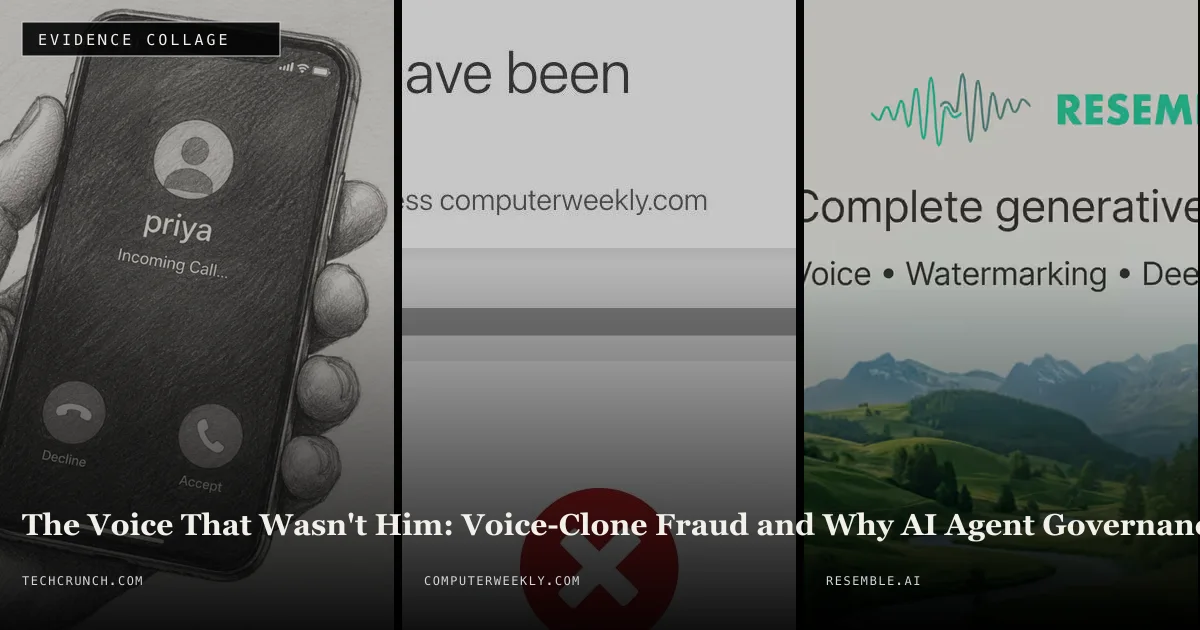
The voice on the line said he'd been kidnapped. He paid the ransom.
It wasn't his brother. It was an AI-generated imitation — a deepfake voice. Tarini Padmanabhuni's grandfather discovered the truth only after the money was gone. What stayed with her, she told TechCrunch this week, wasn't the money. "It was that he had no way of telling." TechCrunch, 2026-09-28
That was two years ago. Today she runs DetectifAI, a San Francisco company building synthetic-speech detection that runs on-device, because the current cloud-based detectors can't be built into phones — leaving the person being targeted with almost no defense. TechCrunch, 2026-09-28
Read that twice. The defense industry's answer to voice fraud is: the victim's phone should be scanning every call. That's where we are.
It's industrial now
This isn't a one-off horror story. It's a business model. The FBI says Americans lost close to $900 million to AI-driven scams last year, up 24% from 2024. People 60 and older lost twice as much as those aged 50 to 59. TechCrunch, 2026-09-28
Yesterday, National Trading Standards in the UK launched its AI Scam Watchlist and released survey data: 47% of UK adults now struggle to tell genuine offers from AI fakes. Voice cloning ranked in the top five AI scam techniques consumers fear most, alongside fake websites, deepfake video, AI-generated images, and digital humans. The agency's verdict: "AI is not necessarily creating new types of scams; it is supercharging existing ones." Computer Weekly, 2026-09-30
The techniques are no longer exotic. A few seconds of public audio — from an interview, a podcast, a social post — is enough to clone a voice. One reported incident this month involved a caller mimicking a man's wife to request credit card details; the fraud was exposed only because she drives an EV and the request was for fuel money. Resemble AI, incident reported 2026-09-13
The criminals don't need the imitation to survive scrutiny. They need it to survive the call.
The business problem
Now bring it home. If you run a company, your people answer phones. Your customers trust voices. Your executives authorize transfers on calls. Every one of those is a surface.
Oregon's Division of Financial Regulation issued a warning on September 14: scammers are using AI voice-cloning to make calls that appear to come from someone the victim knows or trusts, and every unexpected financial request should be independently verified. Statesman Journal, 2026-09-16
"Slow down and independently verify" is good advice for a person. It is not a system. A business can't scale "be careful." It can only scale a chain.
Verification chains beat vibes
Here's the principle: a voice is not an authorization. It never was — we just never had the technology to forge one cheaply, so we pretended it was enough.
A governed agent doesn't accept identity as a vibe. It runs a chain: Intent (what is being requested) → Evidence (what proves the requester is who they claim) → Governance (what rules apply) → Decision → Authorization (a human tap or a delegated, auditable permission) → Audit (the trail, always).
The fraud economy works by breaking chains: spoof the identity, skip the verification, rush the authorization. The defense is to make the chain unskippable. No voice — real or cloned — moves money, discloses data, or commits a company without the evidence and authorization steps attached.
That applies to the agents you deploy, too. Every company rushing to put voice agents on phones is adding thousands of new "voices" that sound like the company. If those agents aren't governed — if a caller can't verify the agent and the agent can't verify the caller — you're not deploying a channel. You're deploying a surface.
The grandfather's story ends with a woman who spent two years building detection. Detection matters. But detection is the ambulance at the bottom of the cliff.
The fence at the top is governance.
— Ronin Inc. DMs open. ronininc.org.