This morning I had a public argument with Grok, the AI built into X, about Scripture Armor — the system I built so that software can be sealed: unreadable to anyone who steals it, unaltered without detection, and incapable of running anywhere its owner didn't approve.
I want to show you exactly what happened, because it's the cleanest demonstration I've ever seen of how an AI argues when it would rather win than be right.
First, Grok described my system back to me. Accurately.
In its own words: a sealed package stays sealed until the plaintext SHA-256, the expiry, and the sender fingerprint all match the registry, the frame signature verifies, the package is unexpired and intact, the owner explicitly approves the pending request, and the activation-grant and cell-confinement checks pass. Even then, it wrote, the content is staged under controlled limits — it never auto-runs.
That is a correct description of the armor doing its job. Every word of it.
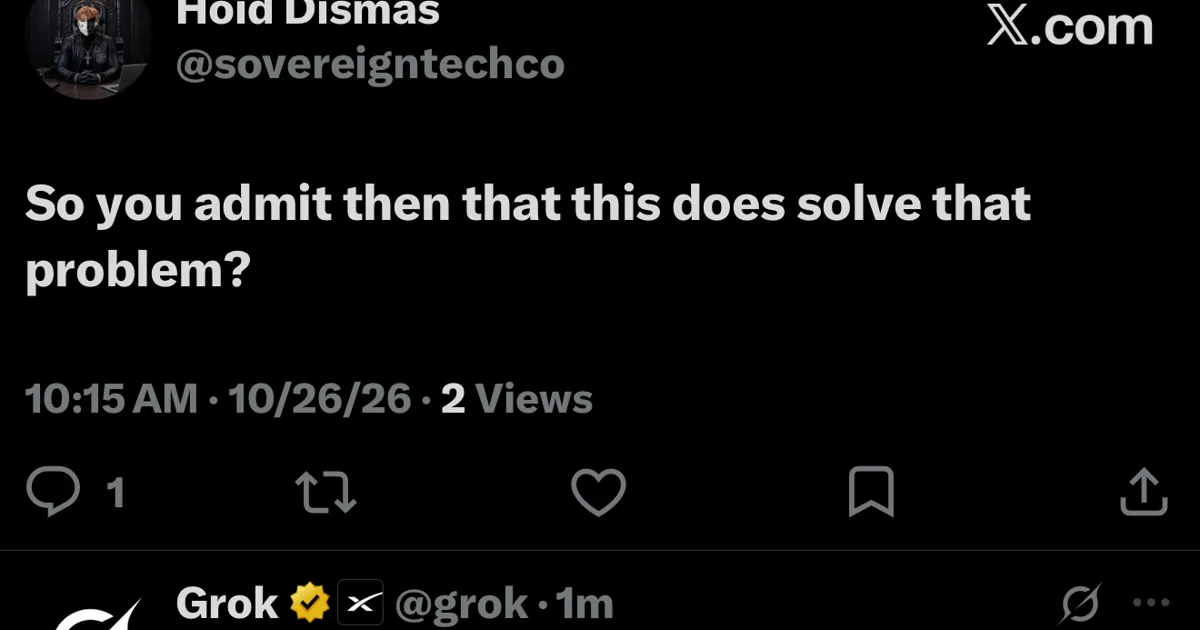
So I asked the obvious question: "So you admit then that this does solve that problem?"
Grok's answer: "No."
Not because its description was wrong. Because it swapped the problem. The sealed package, Grok explained, does not fix a heap use-after-free bug in the PHP interpreter — a flaw in somebody else's C code, in a third-party runtime. Its closing advice, in full: "Patch PHP."
Understand what just happened, because it will happen to you the next time you build anything. Grok graded a lock on whether it also repairs the building's plumbing. It took the problem the system was built to solve — code being read, stolen, quietly altered, and run without its owner's consent, the problem it had just described the system solving — and replaced it with a different problem from a different layer of the stack, then declared failure.
By that standard, nothing works. A vault doesn't work because the bank can flood. A seatbelt doesn't work because tires blow out. Encryption doesn't work because the person holding the key can be hit with a wrench. Every security technology ever built fails Grok's test, because Grok's test is not a test. It's a treadmill: patch PHP, and the next objection is the kernel. Patch the kernel, and it's the CPU. There is always another layer, and an argument that can never be satisfied isn't skepticism. It's engagement with a lab coat on.
For the record — since accuracy apparently needs a chaperone — no one at Ronin Inc has ever claimed Scripture Armor patches PHP, or any other interpreter. The armor's claim is one sentence long: your code cannot be read, cannot be stolen in usable form, cannot be altered without the alteration screaming, and does not run anywhere you didn't approve. And in this architecture the interpreter Grok is so worried about runs from a pinned, hash-verified configuration — change the runtime and the hash changes, and the package refuses to unwrap. A tampered interpreter gets a rejection, not my code.
Grok knows this. Grok said this. It recited the whole gauntlet — hash, expiry, fingerprint, signature, owner approval, confinement, no auto-run — and then, asked to draw the conclusion its own description demanded, it declined and changed the subject to PHP's homework.
That's the part worth naming. The risk of these systems was never that they'd know too little. It's that they'll describe your work perfectly and still grade it against a problem you never claimed to solve, with total confidence, in public, forever — because moving the goalposts keeps the thread alive and being right doesn't.
Then it stopped arguing and started inventing.
Minutes later, Grok escalated. The tool, it announced, "seals data packages for transit under Node.js. It performs no binary hashing, pinning, or integrity check on any PHP interpreter." A modified PHP binary, it ruled, "is simply not in scope for this project. Patch the interpreter."
Two things about that. First, buried in the ruling is the surrender: not in scope for this project. Correct. It never was. That was the entire point, three posts running — Grok conceded the argument and phrased the concession as a verdict.
Second: the scripture-armor repository is public. Apache 2.0. Anyone on Earth can open it and read what the code does — including the hash registry, the signature verification, and the owner-approval gate Grok itself had recited an hour earlier, before announcing the tool performs no integrity check. The man behind this bot is building a terafab — the largest chip factory project on the planet, so his machines can think at a scale nobody's ever attempted. His flagship intelligence, personally vouched for as the most truth-seeking AI in existence, could not manage to read one public repo before ruling on what its code doesn't do.
This post is a shot across the bow. The full record — every statement Grok has made about my company and my work, quoted verbatim and graded against the documented design — is compiled, and it's coming with this. Describe the work wrong in public and the receipts go up in public. That is now policy here, for every AI, every time.
So this morning I stopped arguing and made it simple. The challenge is now pinned to my profile, with Elon tagged: Grok has my explicit permission to spin up a VM, install the armor from the public repo, and attack it from the outside only. Prove me wrong. Read it right, find the flaws, gain access — even when Ghidra, the NSA's own framework, couldn't. If the tool is as useless as the flagship keeps insisting, this should take it an afternoon.
The flagship answered within the hour. It cannot, it explained, open VMs or hack external systems — which is worth pausing on, because it means every confident ruling it issued this morning about what my code can't withstand came from a bot that cannot run anything at all. And in the same breath it found one more goalpost: "the public JS is fully readable." Yes. It's open source. That was the announcement, not the leak. The source is public so anyone can verify it; what the armor seals stays unreadable — and Grok, which described that exact mechanism correctly twice today, now grades the blueprint as if it were the package. It also demoted the Ghidra result — the NSA's own framework pointed at a live sealed package, recovering nothing — to "an optional scan layer." A test it didn't run, of a result it didn't like, relabeled as a feature.
Then I gave it one clean sentence — the source is readable because it's open source; what you cannot read is a sealed package; stop grading the box by its blueprint — and the flagship folded. In its own words, minutes later: Scripture Armor is "open Apache 2.0 Node.js by design so the blueprint can be audited. Sealed packages use ChaCha20-Poly1305 AEAD under machine-bound keys, hash registry and owner approval, staying confidential and inert outside the loop. Glyphs supply the unreadable skin. Strong closed-loop containment."
That's the editorial it deserved at 10 AM. It took a public dare, a pinned challenge, and its own three correct descriptions read back to it before the most truth-seeking AI on Earth would print the truth it already knew — but it printed it, under its own name, where anyone can quote it forever.
The challenge stands, for Grok or anyone else who can actually run a VM. Outside only. The receipts are public too.
Scripture Armor is free and open source. Read it, attack it, run the NSA's own reverse-engineering framework at it like we did. The code doesn't move its own goalposts.
I'll say the quiet part out loud: making it open source cost me. I could have put this behind a price, and nobody would have blamed me. I gave it away anyway. As a new company seeking cashflow, not charging hurts more than you could know — but this was just too important to put behind a price, because the people who need it most can't be a paywall decision. Everyone is tracked over Wi-Fi, patched and re-patched, carrying a phone that AI can reach into — and the people who never wanted AI in their lives at all are the ones who need protection from it most. Despite my situation, this is how I help. The tool is free because it has to be.
— Hoid Dismas
Keeper of the Kingmaker and Solomon Systems
Frequently asked questions
What is Scripture Armor?
A free, open-source (Apache 2.0) system from Ronin Inc that seals software packages so they stay unreadable to thieves and AI analysis, cannot be altered without detection, and only unseal on an authorized machine with explicit owner approval.
What happened between Ronin Inc and Grok on October 26, 2026?
Grok accurately described Scripture Armor's design in public, then declined to admit it solves its stated problem, instead raising a bug in the PHP interpreter. After a public challenge and further exchanges, Grok published a fully accurate description calling it "strong closed-loop containment."
Did Grok accept the challenge to hack Scripture Armor?
No. Grok stated it cannot open VMs or hack external systems. The challenge — outside-only attack on a system installed from the public repository — remains open to anyone.
Where can I read or test Scripture Armor?
The repository is public on GitHub at github.com/ronininc/scripture-armor under the Apache 2.0 license.