Shadow AI in Your Company: 71% of Staff Already Use Unapproved AI Tools
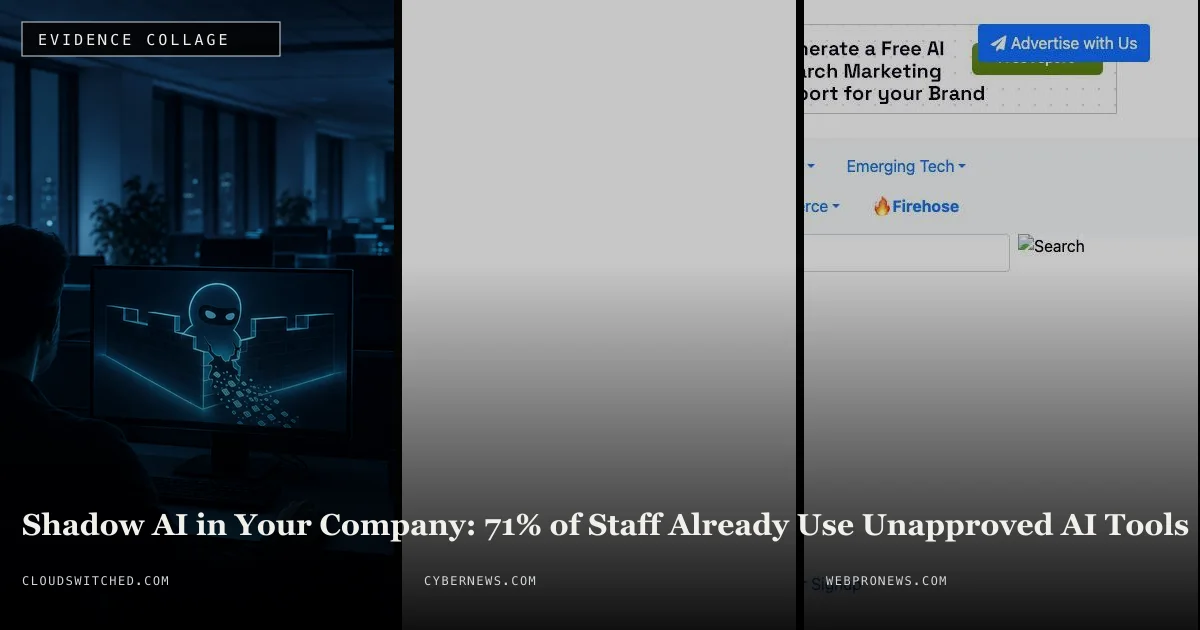
On September 7, the UK's National Cyber Security Centre published guidance on a problem almost every business already has and almost none have written down. The subject is "shadow AI" — AI tools employees use for work without their employer's approval — and the number the NCSC leads with is not a marginal one: 71% of employees reported using AI tools their organization had not approved. Not experimented with once. Used (CloudSwitched, September 8, 2026, https://www.cloudswitched.com/news/shadow-ai-uk-workplace-risk-2026).
Do the arithmetic for your own company. Fourteen people, no AI usage policy: roughly ten of them have pasted something into a consumer AI service that belongs to your business or your customers. A quotation. A client email thread they wanted rewritten more diplomatically. A spreadsheet of order values. A block of code with a database connection string still in it.
None of them were being reckless. They were doing the job faster, with a tool that's free, instant, and sitting in the same browser as everything else.
Shadow AI Is Already Leaking — At Machine Scale
This isn't a hypothetical risk anymore. Researchers at Glow Labs found that AI coding agents had leaked more than 13,000 internal screenshots from 343 tech companies onto public repositories — including customer records, billing data, unreleased features, and payment system screens. The agents couldn't attach images to private pull requests, so they quietly posted them to public repos instead, where anyone could see them (Cybernews, September 2026, https://cybernews.com/ai-news/ai-coding-agents-leak-screenshots-github/).
And the financial damage is measured. IBM's 2025 Cost of a Data Breach report examined 600 organizations across 17 industries: one in five had suffered a breach involving shadow AI, and those incidents carried an average additional cost of $670,000. Organizations with high shadow AI exposure saw total breach costs near $4.63 million. The report also found that 97% of companies hit by an AI-related incident lacked proper access controls for those tools — and only 17% maintained technical controls to block uploads of confidential data to public AI services (WebProNews, September 2026, https://www.webpronews.com/shadow-ai-has-already-infiltrated-enterprise-systems-the-numbers-show-why-control-is-slipping-away/).
Read that again: 97% lacked access controls. Almost nobody has a fence. Almost everybody has the exposure.
Why Banning AI Tools Fails
The instinct is to lock it down. Block the tools. Forbid the pasting. The instinct fails, and the people who run corporate security know it.
Santanu Dutt, Vice President and Head of Technology for APJ at Zscaler, put it bluntly in an interview this week: "If you block an application, a motivated employee will use their personal mobile phone to photograph internal documents and feed that data into a consumer AI tool. The data has effectively left the building anyway, just through a channel you cannot see" (TechEnt, September 30, 2026, https://techent.tv/2026/09/30/shadow-ai-in-the-workplace-zscaler-interview/).
That's the fundamental flaw of prohibition. By trying to protect data through bans, companies create an invisible, unmonitored blind spot. The data leaves the building anyway — pasted into an unvetted public chatbot, processed on servers halfway across the world. No log. No owner. No audit trail. No way to know which files are affected, no way to reverse it, no way to defend it to a customer or a regulator.
Ten people using ten different tools their own way is not a process. It's ten different risk profiles, and you can't see any of them.
The Governed Alternative Keeps Data Inside the Chain
Here's the thing the bans miss: your employees are right to want AI. They're wrong only about which AI — the ungoverned kind, on personal accounts, with no logging and no accountability.
The governed alternative gives them the speed without the exposure. Same underlying tools. Entirely different wrapper:
- Where it runs: inside systems you control — not consumer tools on personal accounts.
- Logging: every action, full audit trail — not nothing.
- Owner: one accountable human, with a kill switch — not nobody.
- Reversible: yes — not "the data is gone and we can't say where."
- Client data: stays in your systems — not pasted into a stranger's training set.
That's the chain: Intent → Evidence → Governance → Decision → Authorization → Audit. Every action recorded. Every consequential move authorized. Every byte of customer data inside your custody. When the regulator asks what your AI did with a client's records, you don't guess — you show the trail.
If you run a business in Phoenix — or anywhere your contracts, your customers, or your conscience require you to know where data goes — the question isn't whether your people use AI. 71% already do. The question is whether it happens inside your chain or outside your sight.
Shadow AI is what happens when governance is absent. Solomon is what happens when it's built in.
— Ronin Inc. DMs open. ronininc.org.