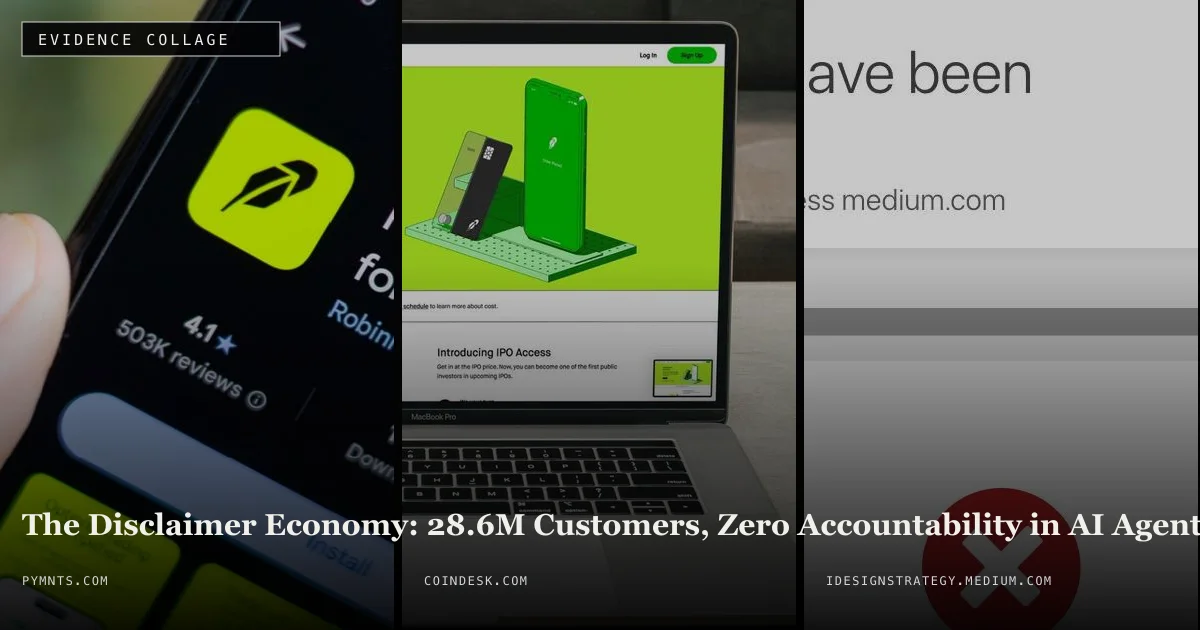
This week Robinhood put AI trading agents inside its main app. The numbers, from PYMNTS: 28.6 million funded customers can now reach them. Nearly 150,000 customers have already opened agentic accounts. Those agents hit Robinhood's tools almost 30 million times a day. PYMNTS, 2026-10-01
Approvals are on by default. One toggle turns them off. After that, the agent trades alone — while you sleep. Their "Loops" feature turns a strategy into a standing instruction the agent repeats around the clock, indefinitely, without a human back in the loop. CoinDesk, 2026-09-30
And here's the line that matters, straight from PYMNTS: if the agent makes a bad trade, the loss is the customer's, even when approvals are off. PYMNTS, 2026-10-01
Read that again. The biggest retail broker in America deployed autonomous money-moving agents at consumer scale, and its answer to "who answers for the outcome" is: not us.
The disclaimer is the product
PYMNTS Intelligence found that among the heaviest AI users, 37% already rely on AI as their main tool for managing money. PYMNTS, 2026-10-01 The demand is proven. The appetite is real. The agents trade 30 million times a day.
But follow the design choice to its end. The customer sets the limits. The customer toggles the approvals. The customer picks the model — OpenAI, Anthropic, Robinhood's own. And the customer carries full responsibility for every trade the agent executes, plus how their data is handled by the third-party language models running it. Robinhood has said it does not supervise, monitor, or audit what the agents actually do. Medium, 2026-10-01
That is not a legal footnote. That is the governance decision. Every company racing to ship an agentic AI feature this year is making the same design choice Robinhood just made publicly: when the system acts without a human confirming each step, who answers for the outcome. Robinhood's answer was to write the broadest possible disclaimer and ship anyway.
This is the business model now
Step back and name the pattern. The industry has converged on a single template: deploy the agent, default the approvals to on, bury one toggle that turns them off, disclaim the outcome, collect the engagement.
It's not just Robinhood. Target treats its agent's choices as the customer's own. The Workday plaintiffs are suing because the hiring machine rejected them with no one answering for it. Intesa Sanpaolo's private banking arm lost roughly €95 million this year to a voice-clone fraud scheme that impersonated its own CEO. informed, clearly, 2026-09-25 The connective tissue across every story this week is the same: the agent acts, the company disclaims, the user absorbs.
The disclaimer economy works until the first catastrophic trade, the first class action, the first regulator who reads the fine print and asks why the company that built the agent, hosted the agent, and profited from the agent isn't responsible for the agent.
Connecticut answered that question in statute today: relying on the tool does not outsource the risk. The FTC is asking it in its rogue-agent probe. The Workday courtroom is asking it in San Francisco.
The open slot
The industry keeps asking "can agents trade?" They already do — 30 million times a day. The question is who built the chain of custody around them.
That's what Solomon is. Every action runs a governed chain: Intent → Evidence → Governance → Decision → Authorization → Audit. Nothing moves money without authorization. Everything leaves a trail. When something goes wrong, there's an answer — not a disclaimer.
Robinhood proved the demand. The regulators are coming with the questions. The only open slot is who supplies the governance.
We do.
— Ronin Inc. DMs open. ronininc.org.