The hiring machine said no. It never said why.
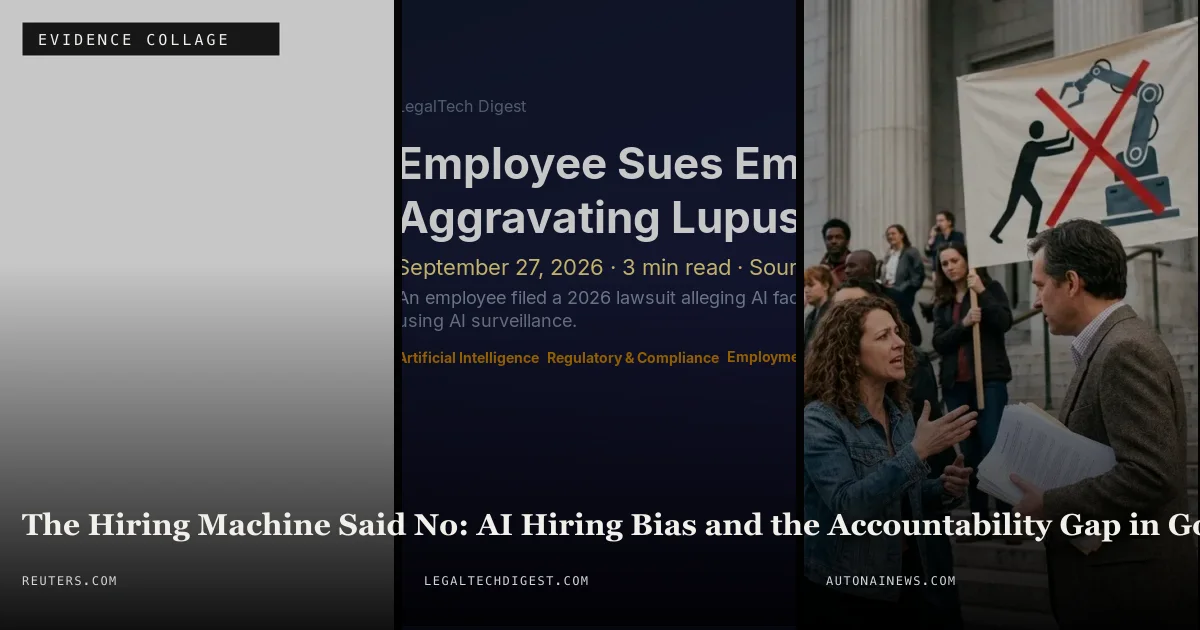
Last week, a group of job seekers asked a federal judge in San Francisco to certify their employment discrimination case against Workday as a class action. The lead plaintiff, Derek Mobley, a Black applicant over 40 with a disability, says he was turned down from more than 100 jobs at companies that used Workday's AI hiring tools. Many of the rejections arrived overnight. No explanation attached. Reuters, 2026-09-21
Workday disclosed that its systems have rejected roughly 1.1 billion job applicants since 2020. The case has already been certified as a nationwide collective action under the Age Discrimination in Employment Act. LegalTech Digest, 2026
Read the plaintiffs' lawyer's line carefully, because it inverts everything the industry assumes: "We do not contend that the AI 'went rogue,'" said plaintiffs' counsel Rod Cooks. "Our concern is that the opposite may be true: an AI system can operate exactly as designed and trained while perpetuating patterns of past discrimination." Reuters, 2026-09-21
The machine didn't malfunction. It worked. And 1.1 billion people got a "no" with no one answering for it.
Who pays?
Reuters put the question in its headline: "But who should pay?" The vendor says its tools "only look at job qualifications — not protected traits." The employers who bought the tools say they were just using the software. Surveys cited in the reporting find that more than 80% of US employers are now using AI somewhere in the hiring process. Reuters, 2026-09-21
Eighty percent of employers. One point of shared software infrastructure. Zero owners of the outcome.
That is not a hiring problem. It is an architecture problem. When a decision is automated, the responsibility for it gets divided between the vendor and the deployer until it belongs to no one. The candidate, meanwhile, gets an overnight email and no appeal.
The regulators have noticed
This is no longer a theoretical risk you can schedule away. New York City's Local Law 144 — requiring bias audits and candidate notice — is now being enforced with real fines for the first time, up to $1,500 per violation per day, after a December 2025 comptroller audit called the previous enforcement approach "ineffective." California's "No Robo Bosses Act" (SB 947) passed the legislature at the end of August and prohibits employers from relying solely on automated systems to fire or discipline workers. AutoNews, 2026-09-30
And today, October 1, Connecticut's CART Act takes effect, requiring employers using automated employment decision tools to give applicants plain-language notice of when and how AI was used — while explicitly stating that using such systems does not insulate an employer from discrimination liability. PYMNTS, 2026-09-29
The legal direction is unmistakable: buying the tool does not outsource the decision.
What a governed system looks like
Every business owner running AI in a hiring funnel, a sales pipeline, or a customer-facing system should sit with this question: if your software rejects, disqualifies, or deprioritizes someone, can you show your work?
Not the model's work. Yours. What data went in. What rule fired. Who authorized the rule. What the trail says when a lawyer asks.
That is what Solomon is. Every action runs a governed chain: Intent → Evidence → Governance → Decision → Authorization → Audit. A rejection is a decision like any other — it enters the chain with its evidence attached, it passes through governance and authorization, and it leaves an audit trail. When someone asks "who decided this," there is an answer. Not a vendor's support ticket. An answer.
The industry spent years arguing about whether AI systems are biased. The wrong question. An AI system can run exactly as designed and still discriminate — that's what the Workday plaintiffs are alleging. The right question is who built the chain of custody around the decision.
1.1 billion rejections. Someone has to answer for them.
We build the systems that can.
— Ronin Inc. DMs open. ronininc.org.