Your Data Center Is Optional: Local-First AI Is the Governed Path
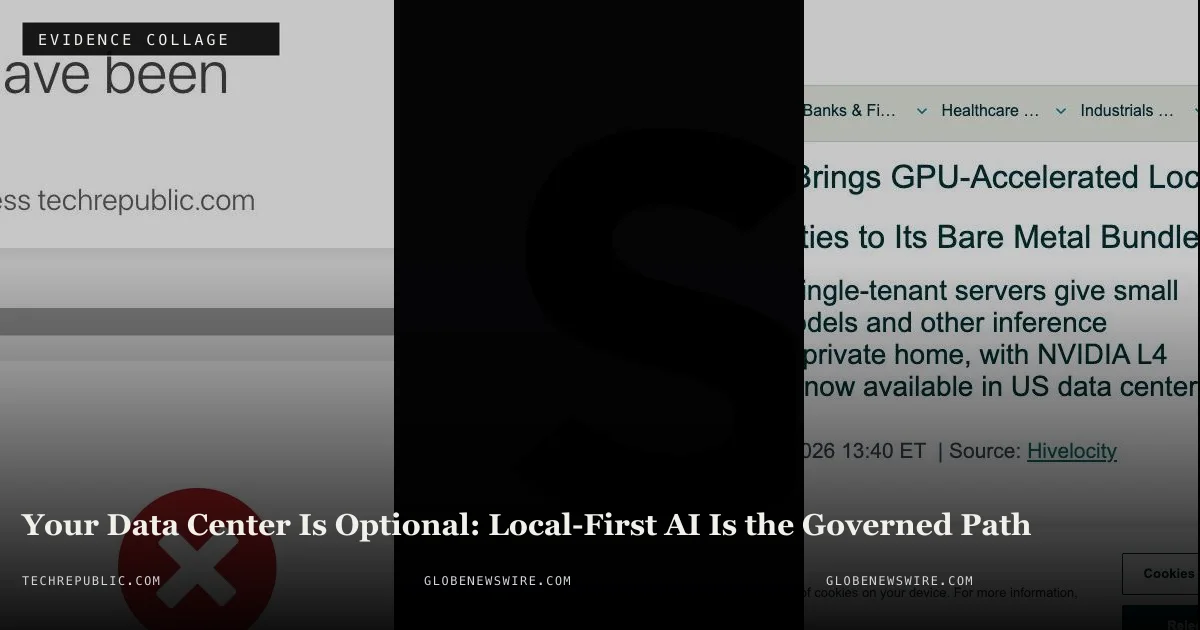
This month, Perplexity shipped something the cloud industry doesn't want you to notice. Portable Computer for Windows puts a local-first AI agent on your PC — the model, the orchestrator, the scheduler, the execution environment all running on the device. It asks your permission before sending a single task to cloud models. No upload, no round trip, no log of your data on somebody else's server, as TechRepublic reported in September 2026 (https://www.techrepublic.com/article/news-perplexity-portable-computer-windows/).
They're not alone. SoundHound announced OASYS Edge on September 24 — fully embedded agentic voice AI for vehicles and smart devices, processing locally so conversations stay private by default and keep working with no network at all, per GlobeNewswire (https://www.globenewswire.com/news-release/2026/09/24/3368388/0/en/soundhound-ai-introduces-oasys-edge-bringing-fully-embedded-agentic-voice-ai-to-vehicles-and-smart-devices.html).
And on September 29, hosting company Hivelocity announced GPU acceleration across its bare-metal bundles, explicitly because its customers are leaving shared, token-metered AI services. Teams are moving to small tuned models in the 3B-to-13B range that they run themselves — a single GPU often serves one in production. "Prompts, embeddings, fine-tuning data, and model weights stay on hardware the customer controls end to end," the company said, calling out data residency, HIPAA, and contractual restrictions on where inference happens (GlobeNewswire, September 29, 2026, https://www.globenewswire.com/news-release/2026/09/29/3371261/0/en/hivelocity-brings-gpu-accelerated-local-ai-capabilities-to-its-bare-metal-bundles.html).
TechCrunch put it plainly in September: on-device AI is challenging the notion that "bigger is better" — smartphone chips now ship with dedicated AI accelerators, and compact models retain the quality that once required billions more parameters (TechCrunch, September 2026, https://techcrunch.com/sponsor/tether/on-device-ai-is-ready-to-challenge-cloud-dominance/).
AI Agent Governance Starts With Where the Model Runs
Here is the part nobody in the cloud sales deck will tell you: you cannot govern what you cannot see.
Every time your agent ships customer data to a third-party LLM provider, you're adding a party to the chain you don't control. Their logs. Their retention policy. Their training pipeline. Their breach surface. Your customer's data, sitting in someone else's evidence locker, under someone else's rules.
Local-first flips that. When inference happens inside your walls, the data never left. The audit trail is yours. The evidence is yours. The authorization happened on your hardware. There is no third party to subpoena for logs they may or may not have kept.
That is not a privacy preference. It is a governance requirement. A governed chain — Intent → Evidence → Governance → Decision → Authorization → Audit — is only as strong as its weakest custodian. If a step in your chain runs on a vendor's cloud with their black-box policies, you don't have a chain. You have a chain with a hole in it.
The Governed Path: Local-First AI
Look at what the September wave actually proves:
The models are small enough. 3B to 13B parameters handle summarization, classification, extraction, retrieval-augmented search, agent and chat back ends — a large share of production work — at a fraction of frontier compute. You don't need a data center. You need a GPU.
The agents run locally. Perplexity's agent runs its entire loop on-device and asks permission before the cloud sees anything. SoundHound's agents run in cars with no connectivity. The "it has to phone home" era is ending.
The economics favor control. Hivelocity's pitch is blunt: fixed monthly line item instead of a per-token bill that scales with usage, plus hardware you control end to end. For a business, predictable cost plus data custody is a better deal than metered mystery.
Regulated work demands it. Data residency, HIPAA, contractual restrictions on where inference happens — these aren't edge cases. If you run a healthcare, legal, or financial operation in Phoenix or anywhere else, your contracts already say your data stays put. Local-first is how you comply without giving up AI.
What This Means for Your Business
The industry spent three years telling you AI means renting intelligence from someone else's data center. September 2026 is the month that story broke. The frontier moved to the edge — to your PC, your server, your hardware, your walls.
And here's the thesis: the governed path was always local-first. Solomon's chain — Intent → Evidence → Governance → Decision → Authorization → Audit — only means something when every link lives inside your custody. Local-first AI gives you the custody. The chain gives you the governance.
Your data center is optional. Your chain of custody is not.
— Ronin Inc. DMs open. ronininc.org.